
Surety in Natural Resources and Energy: A Smarter Approach to Financial Assurance
Surety bonds offer operators a more capital-efficient path to meeting regulatory obligations — without sacrificing liquidity or credit capacity
By: Kulvir Gill, Vice President of Mining and Mason Nowak, Vice President of Energy
Meeting Regulatory Obligations
In Canada, the United States, Australia, and many other jurisdictions globally, reclamation, abandonment, decommissioning, and closure obligations are a critical part of the mining and energy asset lifecycle. These obligations can include well plugging and abandonment, facility dismantlement, pipeline and infrastructure removal, site remediation, land restoration, water management, and monitoring. Beyond being a regulatory requirement, successful closure is essential to maintaining community and stakeholder confidence, while ensuring responsible development of natural resources.
To ensure taxpayers and communities are not left on the hook to pay for and remediate environmental liabilities, regulators commonly require operators to provide financial assurance to guarantee these obligations. While this guarantee can be made in different forms, some, such as cash deposit or a letter of credit (LC), come with trade-offs.
Increasingly, natural resources companies and regulators alike find that surety bonds are the best option to ensure operators meet their financial assurance requirements, while preserving liquidity and financial flexibility.
What is a Surety Bond?
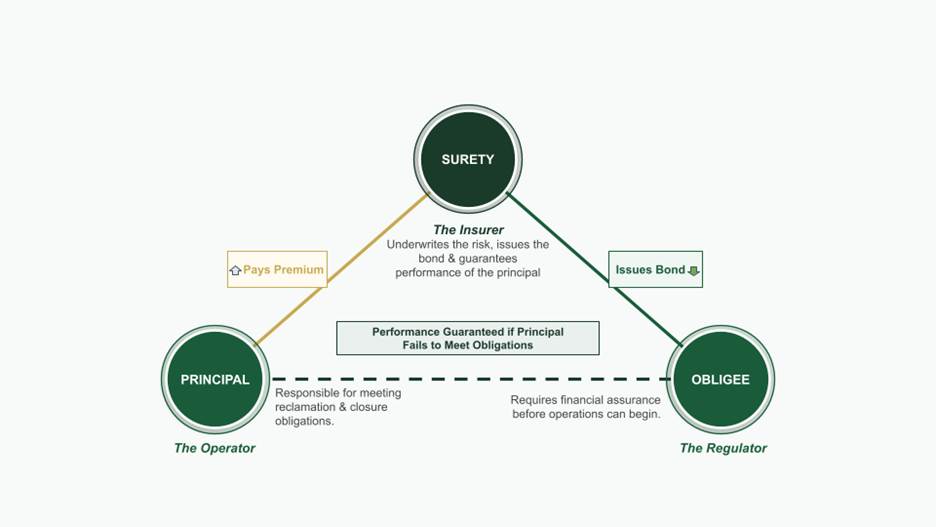
A surety bond is a financial guarantee underwritten by an insurance carrier that ensures a company will fulfill a specified obligation, such as reclamation or decommissioning of a natural resources or energy project. It is an agreement among three parties.
Key Benefits of Surety Bonds for Natural Resource Operators
1. Preservation of Working Capital and Credit Capacity
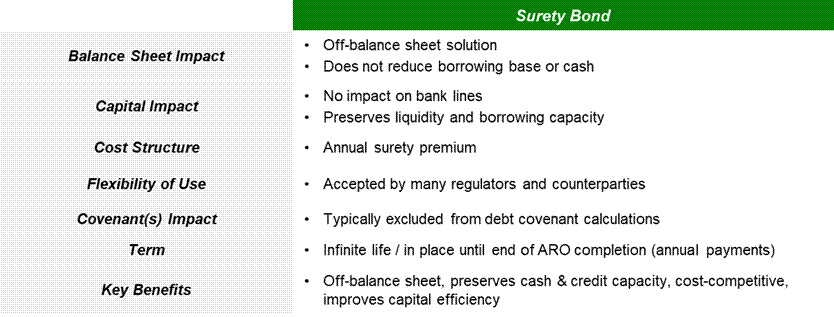
LCs generally consume bank credit capacity and reduce borrowing flexibility under a company’s credit facilities. This can constrain liquidity and limit access to capital for core business needs such as drilling programs, development projects, acquisitions, or other strategic initiatives. Cash collateral similarly ties up funds that could otherwise be deployed into operations or growth. Surety bonds, by contrast, are off-balance-sheet instruments for operators and generally do not reduce a company’s borrowing base or revolving credit availability, allowing operators to preserve liquidity and maintain greater financial flexibility.
2. Lower Cost of Capital
Surety bond premiums can be lower than LC pricing or the opportunity cost of posting cash. Pricing is driven by underwriting considerations that include asset quality, operational profile, and company creditworthiness, whereas LCs often carry issuance fees, annual renewal costs, and can impact bank capacity.
3. Improved Financial Flexibility
Surety bonds allow operators to meet regulatory financial assurance requirements while keeping cash and credit lines available for drilling, development, maintenance capital, and corporate purposes. This makes surety an attractive complement to broader capital structure and liquidity management strategies.
4. Enhanced Regulatory Compliance
Across Canada and the U.S., many mining and energy regulators accept surety bonds as an approved form of financial assurance for plugging and abandonment, reclamation, decommissioning, and related environmental obligations. Surety can therefore support compliance while aligning with the broader policy goal of responsible resource development.
5. Long-Term Security
Surety bonds are evergreen instruments and provide long-dated support for liabilities that extend over many years. This can reduce administrative burden relative to LCs, particularly for operators managing large portfolios of wells, facilities, or infrastructure with long-tail closure obligations.
KEWA’s Differentiated Approach
Our team includes professionals with direct backgrounds in natural resources capital markets, mine finance, and energy asset management. When we evaluate a surety application, we assess not just the operator’s balance sheet but the underlying asset: its quality, its liability profile, and the regulatory environment it operates in.
That deeper analysis allows us to structure solutions for operators and assets that work better for our customers and regulators — and to move with the speed and certainty that complex transactions require. For natural resource and energy operators looking for a surety partner who understands the business, not just the bond, that distinction matters.
To learn more about how our surety solutions can support your business, contact the team at info@kewafinancial.com.